
The Dark World of Fake Wines: From Vintage Wine Fraud to Supply Chain Enforcement
Few things capture the romance of human craftsmanship quite like a rare bottle of wine. Whether it is a velvety Bordeaux or an elusive, highly sought-after Pinot Noir, a vintage wine is a liquid time capsule. But where there is cultural prestige, astronomical price tags, and fragile lines of provenance, organized crime is never far behind.
An eye-opening interactive report by The Economist titled Pinot Noir: Inside the Criminal Gangs Making Fake Wine lays bare how sophisticated illicit syndicates have turned rare winemaking into an industrial-scale deception. As the global appetite for rare bottles surges, fighting back requires more than just a refined palate; it demands rigorous brand protection, legal enforcement, and supply chain security.
The Modern Evolution of Wine Fraud: Lessons from The Economist
The recent investigative deep-dive by The Economist highlights a chilling reality: wine counterfeiting has evolved, and today's syndicates operate with transnational precision. They target high-value, low-yield varieties, most notably Pinot Noir, whose fragmented ownership, legendary micro-terroirs, and astronomical collector demand make it a prime target for exploitation.
These criminal rings understand the nuances of the market. They mimic estate-specific packaging, recreate intricate wax seals, source aged corks, and manipulate chemical profiles so that the liquid inside can pass muster during casual tastings. To collectors and investors, buying a rare bottle has increasingly become a high-stakes gamble against unseen counterfeiters.
The Crusade Against Counterfeiting
To truly understand how deep this rabbit hole goes, one only has to look back at the most infamous case in modern counterfeiting history: Rudy Kurniawan.

In the early 2000s, a young, charming Indonesian-born collector swept through the elite wine scenes of Los Angeles and New York. Dubbed "Dr. Conti" for his seemingly bottomless supply of rare Domaine de la Romanée-Conti and old Bordeaux, Kurniawan dazzled the world’s wealthiest connoisseurs. At a single 2006 auction, he famously sold a staggering $24.7 million worth of fine wine.
The bubble burst when astute producers and collectors began noticing glaring chronological impossibilities. In some cases, Kurniawan sold bottles bearing dates decades before the named estate began producing that series.
When the FBI raided his California home in 2012, they found a laboratory for fraud: thousands of sorted vintage corks, custom rubber stamps, precise handwritten notebooks detailing cheaper, California wine blends engineered to mimic the taste of pricey French Burgundies, and funnels lined up on the kitchen counter. Kurniawan was eventually convicted of wire and mail fraud, serving a federal prison sentence before being deported for overstaying his visa. Yet, experts warn that thousands of his forged masterpieces still sit undetected in private cellars around the globe.
Guarding the Cellar: How Wine Producers and Collectors Can Fight Back
The exploits of Kurniawan and the sprawling modern criminal syndicates exposed by The Economist prove that the wine industry can no longer rely on an "honor system." Protecting intellectual property (IP), brand integrity, and consumer safety requires active, on-the-ground defense.
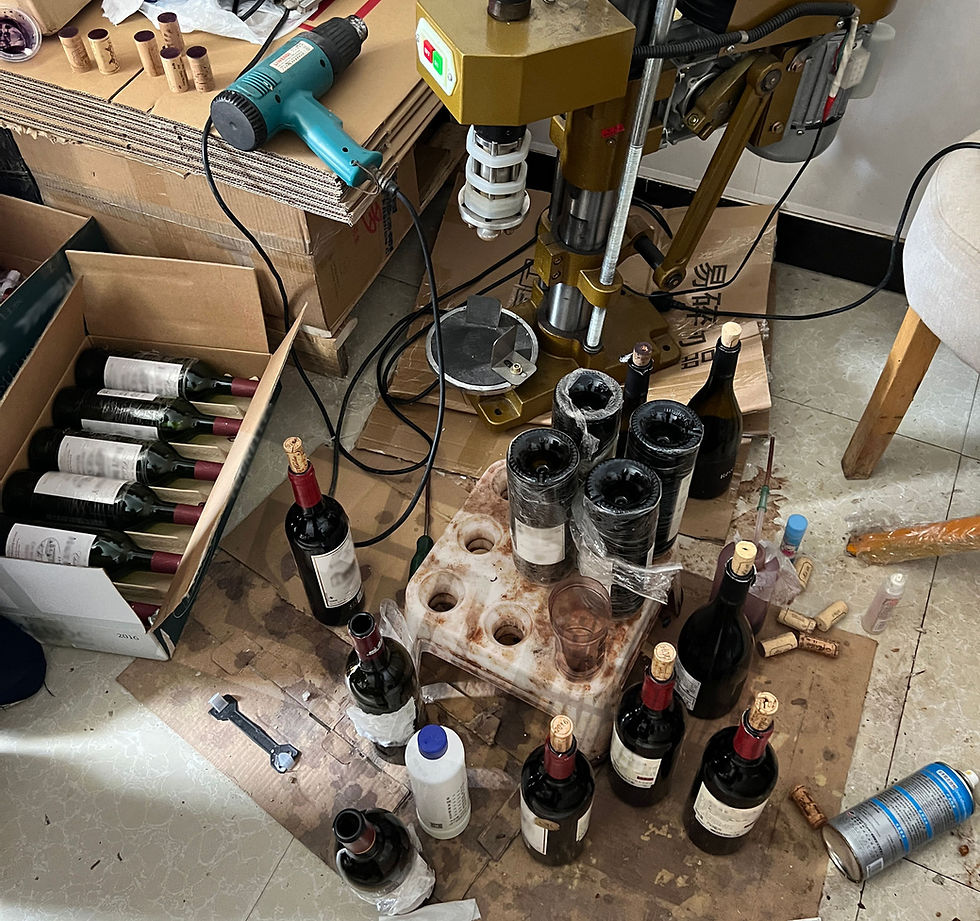
This is where specialized brand protection agencies like the Selective Trademark Union (STU) play a critical role. With over 40 years of experience fighting intellectual property theft across Asia and international supply chains, STU provides comprehensive anti-counterfeiting services tailored to luxury goods and fine-wine producers:
On-the-Ground Investigations: STU’s undercover teams track down illicit factories, printing operations, and distribution networks to uncover where fake vintages originate before they hit international auction houses.
Direct Law Enforcement Collaboration: STU works hand-in-hand with local authorities and customs agencies to execute raids, seize counterfeit materials, and shut down manufacturing facilities.
Marketplace Surveillance: Following enforcement actions, continuous monitoring across online and offline marketplaces ensures that criminal networks cannot easily re-establish operations under a new guise.
Supply Chain & Asset Protection: By offering tailored training for authorities and rigorous tracking protocols, STU helps wine houses safeguard their brand positioning, ensuring that collectors receive the authentic product they pay for.
The allure of rare wine will always attract those looking to profit from luxury and prestige. As The Economist demonstrates, the criminals are becoming bolder and more organized. However, by combining heightened industry skepticism with aggressive, professional anti-counterfeiting measures from organizations like the Selective Trademark Union, the global wine market can begin to shut the cellar door on fraud once and for all.
Contact our team today to learn how our on-the-ground investigations can trace your counterfeiters from the digital screen to the factory floor.
Let's stay one step ahead of counterfeiters and protect the brands that matter most!
Please reach out to us today for further information regarding our services.
40 Years of Experience in Protecting Intellectual Property. At Selective Trademark Union (STU), we know how important intellectual property (IP) is to brand owners, and we are dedicated to safeguarding it. Check our website at www.stu.net for more information.
Article References:
The Economist. (2026, November 6). Pinot Noir: Inside the criminal gangs making fake wine. https://www.economist.com/interactive/2026/11/06/pinot-noir-inside-the-criminal-gangs-making-fake-wine
Wallace, B. (2012, May 13). Château Sucker: The rise and fall of Rudy Kurniawan, the ultimate wine fraudster. New York Magazine. https://nymag.com/news/features/rudy-kurniawan-wine-fraud-2012-5/Keefe, P. R. (2007, September 3). The Jefferson bottles: How could one man have so much rare wine? The New Yorker. https://www.newyorker.com/magazine/2007/09/03/the-jefferson-bottles
Federal Bureau of Investigation. (2012, March 9). Wine fraudster arrested in California for scheme to sell millions of dollars in counterfeit wine. U.S. Department of Justice. https://www.justice.gov/
Walton, S. (2024, March 1). Wine fraud: A fascinating chronicle of vinous crimes. The World of Fine Wine. https://worldoffinewine.com/news-features/wine-fraud-fascinating-chronicle-vinous-crimes

Comments